

When the Australian Bureau of Statistics (ABS) released the Socio-Economic Indexes for Areas (SEIFA) 2021, it provided a snapshot of advantage and disadvantage across the country.
SEIFA serves as a policy tool that guides government funding and welfare planning.
But when combined with other datasets, it becomes something much more powerful: a foundation for commercial, strategic, and community decision-making.
We explore how SEIFA, when connected to complementary data, can unlock insights that informs decisions such as shaping retail strategies to infrastructure planning and more.
What is Socio-Economic Indexes for Areas (SEIFA)?
SEIFA is a set of indexes created from Census data that summarise socio-economic conditions across Australia. It includes four core measures:
- Index of Relative Socio-Economic Advantage and Disadvantage (IRSAD)
- Index of Relative Socio-Economic Disadvantage (IRSD)
- Index of Education and Occupation (IEO)
- Index of Economic Resources (IER)
Together, these indexes provide a lens on inequality, highlighting where communities sit on the spectrum of economic and social well-being.
Building the Data Foundation
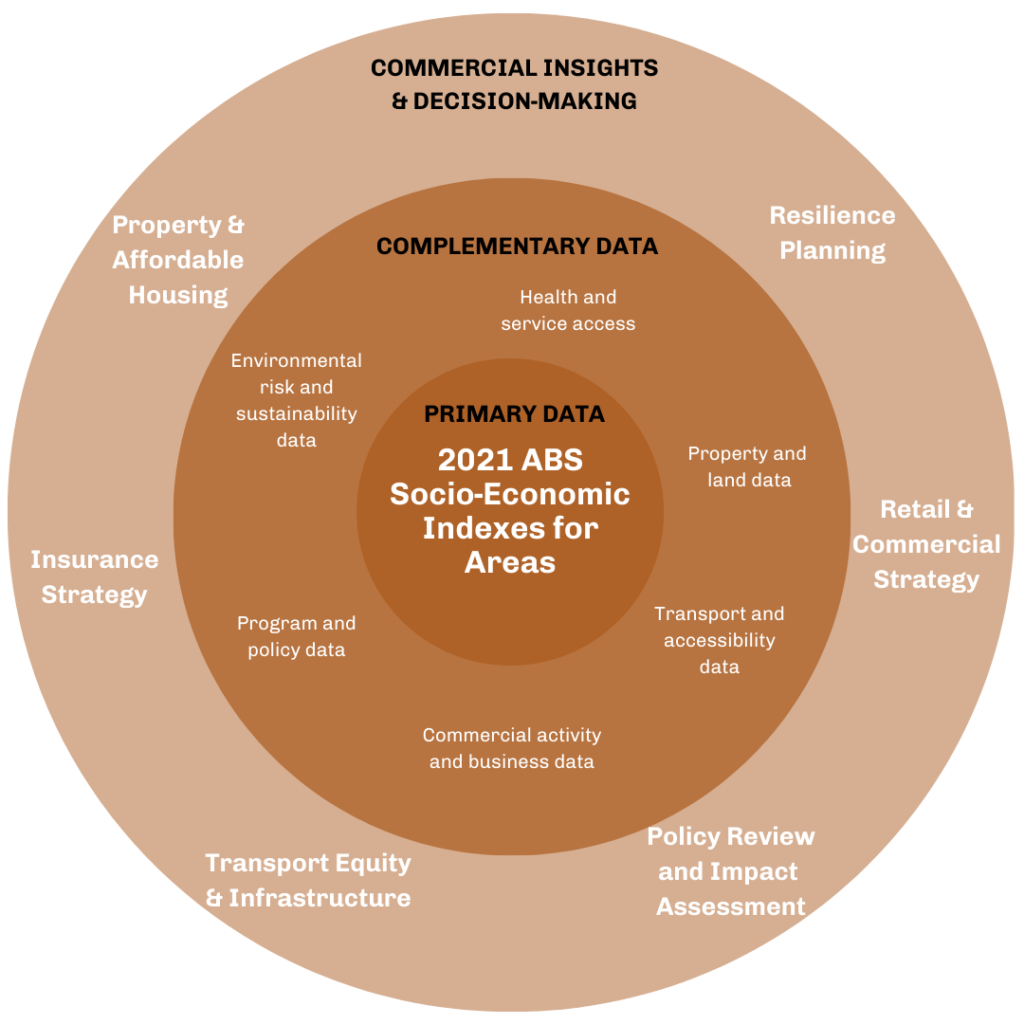
By itself, SEIFA is valuable. But when integrated with other datasets, it can offer even more powerful insights. Some of the most impactful complementary layers include:
- Health & Service Access: Hospitals, GPs, aged care, and schools.
- Transport & Accessibility: Public transport networks, travel times, digital connectivity.
- Property, Construction & Land Data: Valuations, zoning, planning overlays, construction activity.
- Business & Commercial Activity: SME density, retail hubs, vacancy rates.
- Environmental Risk & Sustainability: Flood maps, fire overlays, climate resilience.
- Policy & Program Data: Community grants, infrastructure investments, government initiatives.
When these layers are combined, SEIFA is no longer just an index, it becomes a decision-making engine.
Commercial and Strategic Applications
Here are six examples of how organisations use SEIFA with complementary data to create real-world impact:
1. Targeted Social Investment
Overlaying SEIFA with health outcomes helps pinpoint communities in need.
For example, NSW HealthStats shows disadvantaged areas have higher hospitalisation rates, guiding healthcare resource allocation where it’s most needed.
Potentially Preventable Hospitalisations (PPH) data from NSW HealthStats shows a pattern by socio-economic disadvantage; areas classified as most disadvantaged (based on SEIFA) have higher hospitalisation rates than the least disadvantaged areas.
2. Retail & Commercial Strategy
Businesses use SEIFA to identify underserved yet demographically promising locations.
SEIFA can help businesses better understand the socio-economic context of the communities they serve, helping to identify locations that may be both underserved and commercially viable.
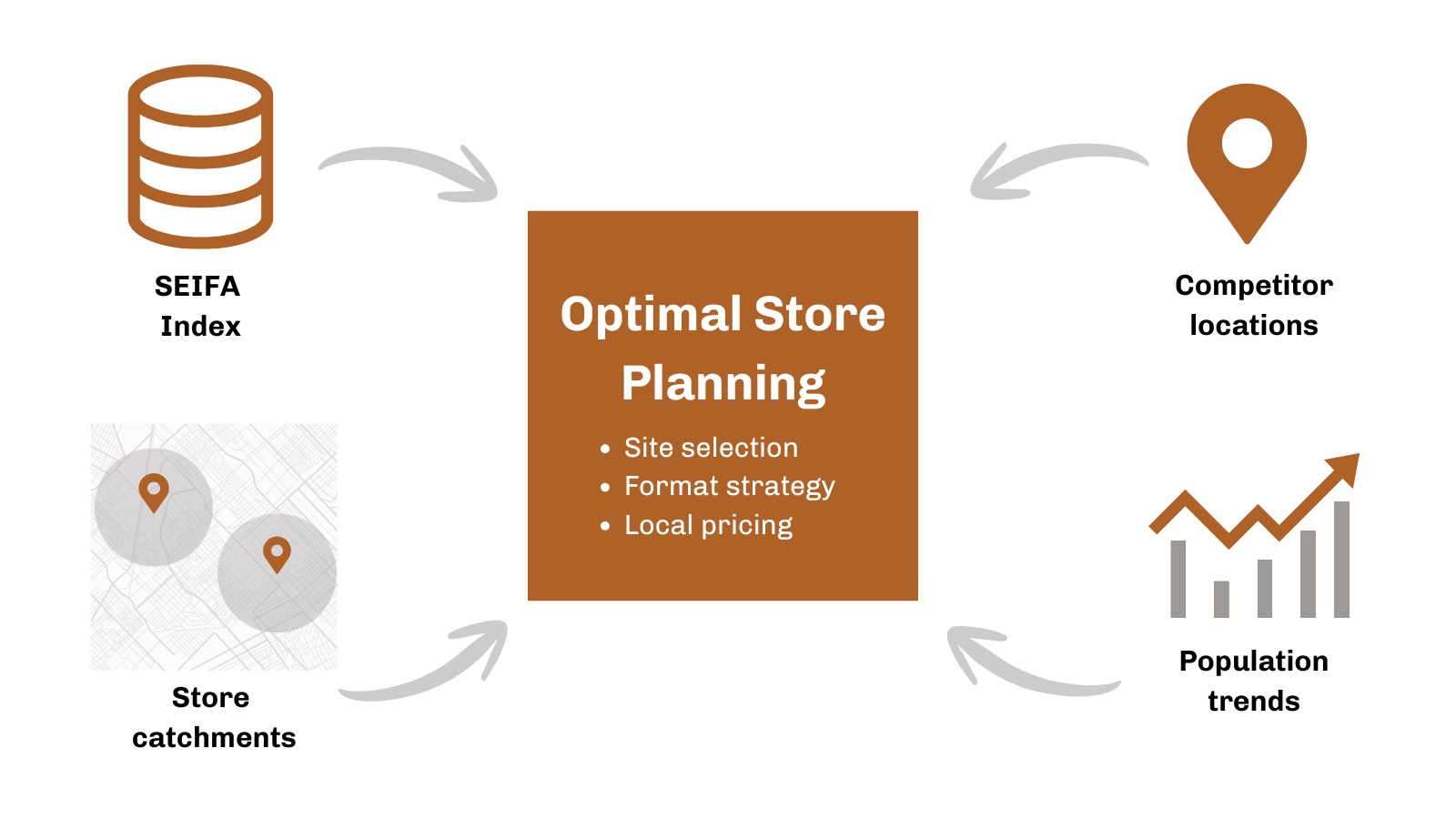
For example, retailers can combine SEIFA with store catchments, competitor presence, and local population trends to gain a clearer picture of where different store formats may resonate. In some areas, value-focused offerings may align more closely with local conditions, while in others, premium formats may be better suited.
These insights can help inform site selection, store planning, and localised ranging and pricing decisions, supporting more considered and context-aware expansion strategies.
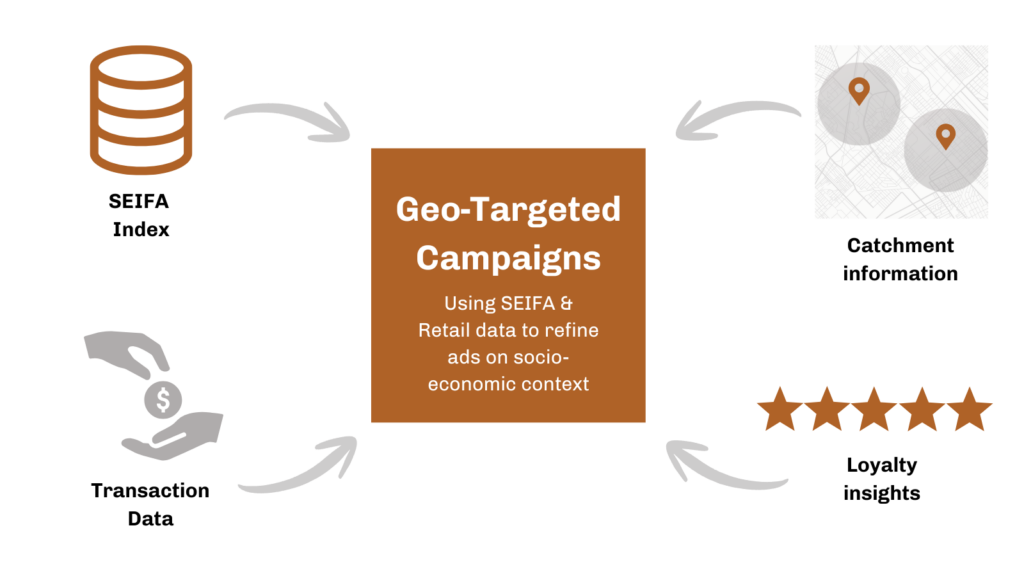
Similarly, retail media networks and agencies can integrate SEIFA with transaction data, loyalty insights, and catchment information to refine geo-targeted campaigns.
Overlaying socio-economic deciles with category performance can highlight where certain products or price points are more likely to gain traction.
For instance, value-oriented household goods or finance offers may see stronger engagement in lower Index of Economic Resources (IER) areas, while premium home, travel, or lifestyle campaigns may resonate more in higher Index of Relative Socio-economic Advantage and Disadvantage (IRSAD) locations.
Rather than applying a uniform national approach, SEIFA supports more locally responsive campaign planning and budget allocation.
This can help improve relevance, reduce inefficiencies, and improve overall marketing effectiveness.
3. Property & Affordable Housing
SEIFA is widely used to determine where funding and services should be directed.
This insight helps housing developers and policymakers target areas with affordability challenges, ensuring investment is aligned with community need.
The Bureau of Communications, Arts and Regional Research notes SEIFA’s role in helping businesses identify new opportunities by highlighting socio-economic strength and vulnerability, as well as determine areas which require funding and services.
4. Transport Equity & Infrastructure
Transport planning becomes sharper when SEIFA is combined with accessibility data.
Deloitte Access Economics research referencing 2011 and 2016 SEIFA data shows disadvantaged areas often face limited access to jobs, education, and healthcare. This evidence supports transport investment in high-need corridors.
5. Resilience & Insurance Strategy
By combining SEIFA with environmental risk overlays, policymakers and insurers can better understand where socio-economic vulnerability and hazard exposure intersect.
Research and recommendations by the NSW Financial Inclusion Network highlights how inclusive insurance systems can help to protect all citizens.
6. Policy Impact Assessment
ABS notes that SEIFA is a key reference point for funding allocation to communities most in need.
In practice, this means SEIFA is often central to place-based decision making.
By combining socio-economic scores with thematic mapping, policymakers and planners can see the spatial distribution of advantage and disadvantage and align funding, programs, and infrastructure investments with the communities that need them most.
Limitations of SEIFA
While SEIFA is a powerful dataset, decision makers should be cautious in how they apply it.
- A relative measure
SEIFA is best understood as a ranking tool. It shows whether one area is more or less disadvantaged compared to another, but it does not quantify the size of that gap.
For example, an area with a score of 500 is not “twice as disadvantaged” as an area with a score of 1000, it is simply ranked lower. - A summary, not individual, measure
SEIFA reflects conditions at the area level, not the household or person level. This means using it to describe individuals can be misleading, as many people within a disadvantaged area may not share the same socio-economic characteristics. - Not designed for time-series comparison
SEIFA cannot reliably be compared across different Census years. Changes to variables, weightings, and area boundaries mean a score in one census year is not directly comparable to another. Where comparisons are necessary, it is safer to use deciles rather than raw scores or ranks. - An incomplete picture
Some areas do not receive a SEIFA score due to low populations or high non-response rates. Certain groups, such as older Australians, are also more likely to appear in lower deciles due to naturally lower incomes, which can skew interpretation. - A subjective measure of disadvantage
The ABS notes that disadvantage is not absolute. It varies across regions and cultures, with different interpretations of which variables matter most. For this reason, SEIFA should never be the only dataset used. A range of complementary measures is always needed for fair, accurate decision making.
The Big Picture
SEIFA is a strategic dataset that, when paired with complementary layers, unlocks insights for a range of practical applications.
While SEIFA can be a powerful foundation, it should always be used with care.
Its limitations mean it works best when combined with other datasets and local knowledge, so that decisions are data-driven, contextually grounded and responsive to community realities.
Data Army believes the true power of data emerges when it’s connected.
SEIFA is a clear example. A dataset created to support social equity that becomes even more valuable when enriched; transforming into intel that supports both public good and commercial intelligence.
ABS SEIFA 2021 Data available now
Data Army Intel provides free, unlimited access to ABS SEIFA 2021 data via the Snowflake Marketplace.
More Intel from Data Army




Intel In Your Inbox
Sign up to our newsletter and receive our latest knowledge articles, practical guides and datasets.