

Before making major property decisions such as developing, financing, investing, or planning, organisations need to understand how the market is behaving.
This typically begins with analysing property prices, sales activity, and broader market trends to assess value and risk.
Most market analysis starts with aggregated indicators such as suburb median prices, quarterly market reports, or high-level sales summaries.
These metrics provide a useful overview of market conditions and help track broad market movements.
However, aggregated statistics do not always tell the full story.
One Suburb Tells Two Different Stories
Consider two homes in the Sydney suburb of Drummoyne, New South Wales (NSW), 2047.
Located about six kilometres west of the Sydney central business district (CBD), Drummoyne sits along the Parramatta River, and includes both quiet waterfront streets with harbour views and properties positioned along major transport corridors such as Victoria Road.

Now consider two homes within that same suburb.
One property may sit on a quiet residential street overlooking the water. Another may sit along Victoria Road, one of the busiest arterial routes connecting Sydney’s inner west with the CBD.
Both homes fall within the same suburb and both contribute to Drummoyne’s median house price.
Yet their values may differ significantly due to factors such as outlook, traffic, noise, and proximity to the waterfront or public transport.
When market activity is summarised into a suburb-level statistic, those differences disappear.
Understanding these variations is often critical when assessing property value, demand, or risk.
What Are The Limitations of Market Averages?
Aggregated statistics such as median house prices simplify complex market activity into a single figure.
That simplicity makes them useful, but it also smooths out variation.
In property markets, that variation can be significant.
Differences in outlook, street position, proximity to transport, or access to amenities can materially influence how properties are valued.
When these factors are averaged into a suburb-level statistic, the diversity of properties within that market is lost.
As a result, relying solely on averages can sometimes lead to incomplete interpretations of market conditions.

What Can Transaction-Level Property Sales Data Reveal?
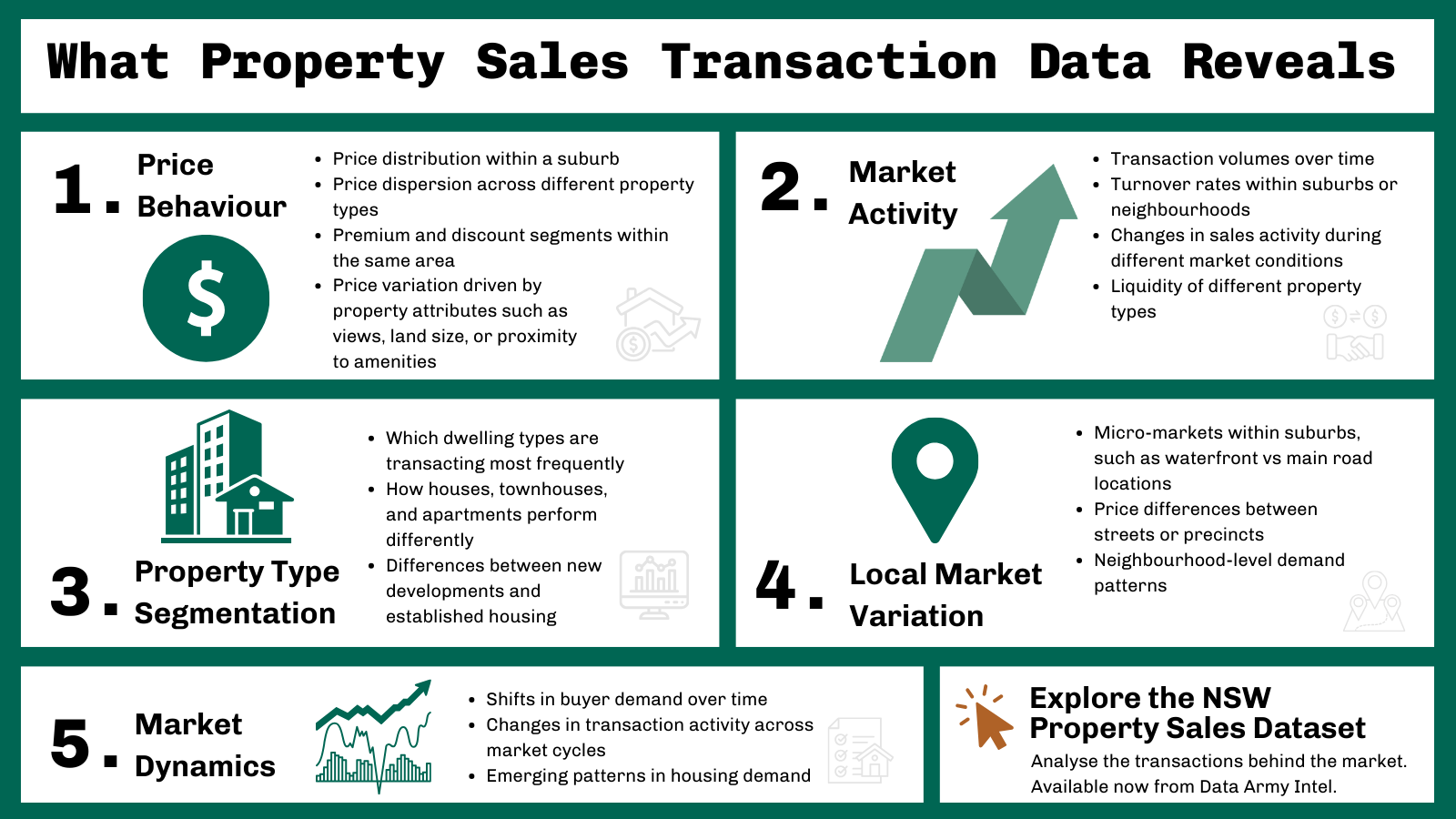
Transaction-level property sales data provides a more granular view of market activity.
Individual transaction records allow analysts to examine how different types of properties are actually transacting within a market.
This includes understanding:
-
the range of sale prices within a suburb
-
the volume of transactions occurring over time
-
the types of properties being sold
-
how prices vary based on property characteristics and location
When combined with property attributes such as dwelling type, land size, location features, or suburb characteristics, transaction data provides a richer picture of how the market behaves.
Instead of relying only on averages, analysts can examine the distribution of prices and activity that make up the market.
Looking Beyond the Median
Returning to the Drummoyne example, a suburb median might suggest a typical house price across the area.
However, the underlying transactions may reveal a much wider spread of values.
Properties with water views or quieter streets may transact at a premium. Homes located on major roads such as Victoria Road may sell at lower price points due to traffic and noise.
Townhouses and apartments may sit within entirely different price ranges again.
Transaction-level data makes these variations visible.
Understanding these differences helps organisations build a more realistic picture of the market.
Developers can better understand what type of product suits a location. Lenders and insurers can assess property value and risk more accurately. Analysts and planners can observe how demand differs even within the same suburb.
Understanding Market Activity
Transaction data also provides insight into how active a market is, not just where prices sit.
By examining individual sales records, analysts can observe:
-
how many properties are transacting in an area
-
which dwelling types are most active
-
how activity varies across neighbourhoods
When transaction-level sales data is combined with property and suburb attributes, organisations gain a clearer view of the market by examining how real properties transact across locations, price points, and property types.
These patterns help reveal how housing demand is evolving and where activity is concentrated within the market.
This deeper level of insight can support a range of assessments including:
-
property valuation analysis
-
development feasibility studies
-
mortgage and insurance risk evaluation
-
market research and investment analysis
-
housing policy and planning insights
What Else Can Transaction-Level Data Reveal?
Looking beyond averages also opens up other insights about how property markets behave.
Transaction-level sales data can help organisations understand:
-
market liquidity, by showing how frequently properties are selling in an area
-
micro-markets within suburbs, where prices can vary significantly between streets or property types
-
buyer demand patterns, revealing which types of properties are transacting most often
-
local supply and demand dynamics, showing where activity is increasing or slowing
Together, these signals provide a more complete picture of how property markets function. Instead of relying solely on high-level indicators, analysts can examine the underlying transactions that shape them.
Looking Beyond Suburb-Level Statistics
Median prices provide a useful summary of the market, but they do not capture the full picture.
Behind every suburb-level statistic sits a wide range of individual property transactions shaped by location, property characteristics, and buyer demand.
Examining those transactions directly provides a more detailed understanding of how property markets function.
Often, the most meaningful insights are not found in the summary statistics themselves, but in the variation behind them.
NSW Property Sales Data
Data Army Intel offers NSW Property Sales Data on the Snowflake Marketplace. Updated weekly, it keeps you aligned with the latest property transactions and market movements.
More Intel from Data Army





Intel In Your Inbox
Sign up to our newsletter and receive our latest knowledge articles, practical guides and datasets.