
What Eurostat Reveals About Spain’s Sporting Success
¡Vamos! Spain are the 2026 FIFA World Cup champions!
Following their 1–0 extra-time victory over Argentina in the FIFA World Cup Final, we were curious to look beyond the result and explore what Europe’s official statistics could tell us about the country’s sporting ecosystem.
According to Eurostat – Population Social Conditions, Spain employed 253,100 people in the sport sector in 2024.
This represents a 70% increase since 2011 (the first year that this data was made available).
The data paints an interesting picture.
| Year | Total | Women | Men | Women % |
|---|---|---|---|---|
| 2011 | 148,300 | 56,900 | 91,400 | 38.4% |
| 2012 | 159,600 | 65,800 | 93,900 | 41.2% |
| 2013 | 164,100 | 73,500 | 90,600 | 44.8% |
| 2014 | 187,900 | 86,400 | 101,500 | 46.0% |
| 2015 | 183,300 | 78,300 | 105,000 | 42.7% |
| 2016 | 192,300 | 74,700 | 117,600 | 38.8% |
| 2017 | 201,800 | 83,200 | 118,500 | 41.2% |
| 2018 | 211,400 | 88,500 | 122,900 | 41.9% |
| 2019 | 216,400 | 87,600 | 128,900 | 40.5% |
| 2020 | 199,100 | 79,000 | 120,100 | 39.7% |
| 2021 | 220,300 | 97,800 | 122,500 | 44.4% |
| 2022 | 231,800 | 98,100 | 133,700 | 42.3% |
| 2023 | 244,700 | 96,900 | 147,900 | 39.6% |
| 2024 | 253,100 | 101,600 | 151,500 | 40.1% |
Top 5 Facts About Spain’s Sporting Sector
- Spain ranks fifth in Europe for sport’s share of total employment (1.17%), well above the EU average of 0.79%.
- Women’s employment in sport exceeded 100,000 for the first time, reaching 101,600 people in 2024. This is almost double the number recorded in 2011.
- Employment among 15–29 year olds grew by 39% between 2019 and 2024, highlighting strong investment in the next generation of sport professionals.
- Following a temporary decline during COVID-19, sport employment recovered quickly, surpassing pre-pandemic levels by 2021.
- While women’s absolute numbers have grown impressively from 56,900 in 2011 to 101,600 in 2024, men’s employment has grown in near-lockstep from 91,400 in 2011 to 151,500 in 2024, keeping the split at roughly 60/40 male/female.
While no single dataset can explain World Cup success, this is exactly the kind of insight official statistics can provide.
Looking beyond the final score reveals the scale of the industry supporting elite sport.
Behind every championship-winning team is an ecosystem of coaches, analysts, sports scientists, medical professionals, administrators, broadcasters, facility managers, technology providers and thousands of others working behind the scenes.
Employment data helps quantify how that ecosystem is evolving over time, providing organisations with a deeper understanding of workforce trends, industry investment and economic activity.
When combined with Eurostat’s broader collection of labour, education, demographic and economic statistics, it becomes possible to build a much richer picture of the forces shaping industries across Europe.
What is Eurostat?
Eurostat publishes millions of trusted data points covering everything from population and inflation to agriculture, trade, tourism and renewable energy.
But what exactly is Eurostat, and why do governments, businesses, researchers and journalists rely on it?
Explore the full picture with Eurostat
Employment in sport is just one example of what can be uncovered using Eurostat’s official statistics.
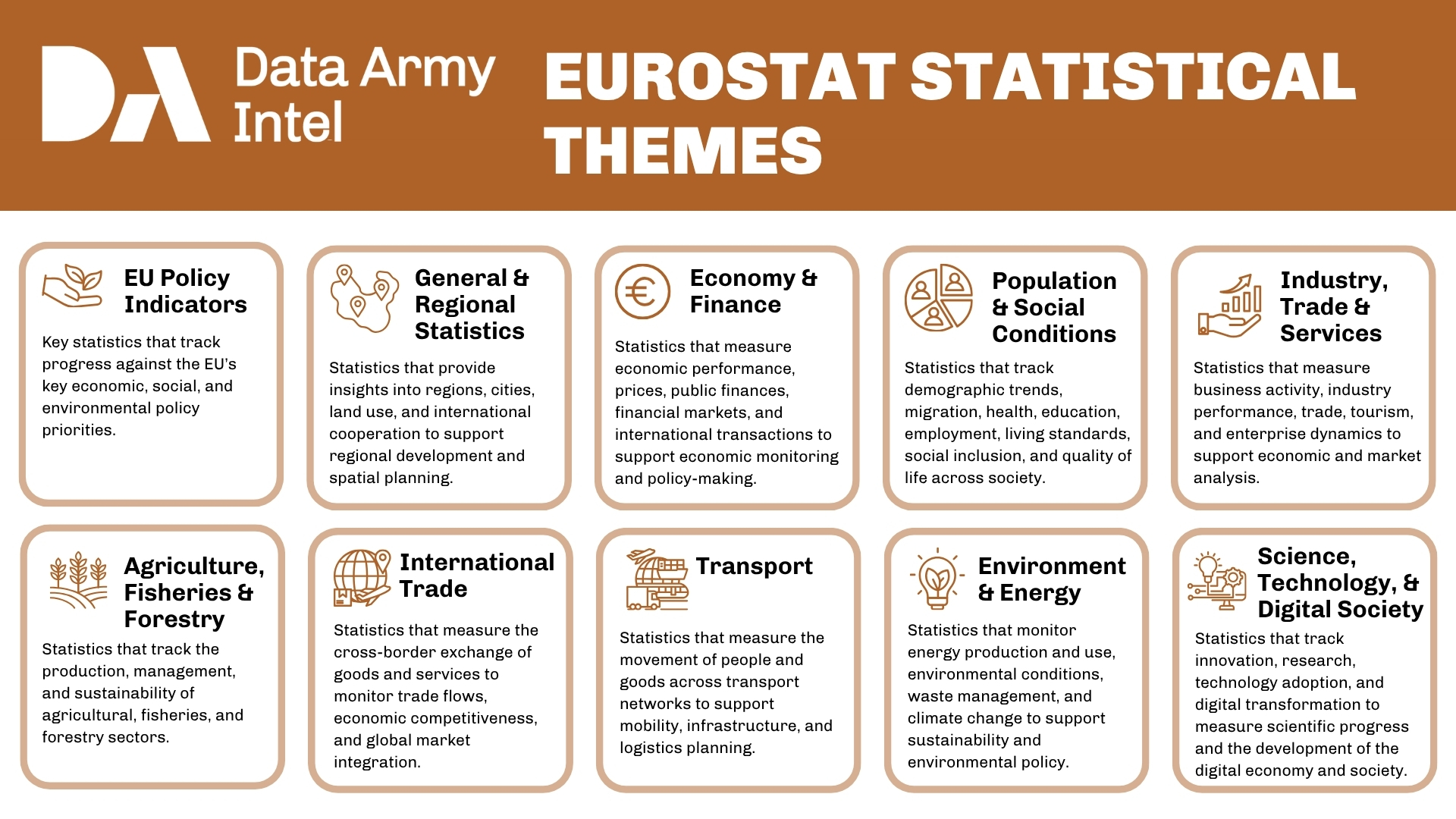
Through Data Army Intel, organisations can access a comprehensive collection of Eurostat datasets covering population, labour markets, economic performance, international trade, transport, agriculture, environment, energy, regional development, finance and much more—all ready to query directly from Snowflake Marketplace.
With zero ETL, trusted European statistics are immediately available for analytics, reporting and AI, eliminating the time and complexity of sourcing, preparing and maintaining data yourself.
Whether you’re analysing workforce trends, evaluating new markets or building AI-ready data products, Data Army Intel makes Europe’s most trusted statistical data easier to access than ever.
Eurostat Data from Data Army Intel
Data Army Intel offers Eurostat data across all ten statistical themes, instantly accessible and ready to query in Snowflake.
More Intel from Data Army





Intel In Your Inbox
Sign up to our newsletter and receive our latest knowledge articles, practical guides and datasets.