

For many years, Geohash has been a widely adopted geospatial indexing system. More recently, H3 has emerged as an alternative approach, offering a different grid structure and set of trade-offs. The choice between them depends on the requirements of your application and how you intend to work with spatial data.
Here, we explore the differences between Geohash and H3 to help you determine which system best suits your needs.
Geohash: A Familiar Approach
Geohash is a geocoding system that encodes geographic coordinates into a short alphanumeric string. It divides the world into a hierarchical grid of rectangular cells, where each additional character increases spatial resolution.
H3: A Different Approach
H3 is a geospatial indexing system developed by Uber. It represents the Earth’s surface using a hierarchical grid based primarily on hexagonal cells, with a small number of pentagons required to account for spherical geometry. Each cell is assigned a unique H3 index, enabling consistent spatial aggregation and analysis.
Comparing Geohash and H3
We explore the key differences between Geohash and H3 across several dimensions.
Precision
- Geohash: Precision increases with the length of the geohash string. However, cell shapes and sizes vary by latitude due to the rectangular grid and projection effects.
- H3: H3 provides near-uniform cell sizes at each resolution level, though areas are not perfectly equal across the globe. Resolution increases by subdividing cells into finer regions.
Spatial Relationships
- Geohash: Neighbour relationships can be less consistent due to the rectangular grid structure, and edge cases (e.g. across hash boundaries) can complicate adjacency logic.
- H3: Hexagonal cells provide more consistent neighbour relationships and reduce directional bias, which can improve spatial analysis and aggregation workflows.
Support and Ease of Use
- Geohash: Geohash is simple, well-established, and widely supported across databases and programming languages.
- H3: H3 has rapidly gained adoption and is now supported across major data platforms (e.g. Snowflake, BigQuery, Python, JavaScript). While newer than Geohash, its ecosystem is mature and actively maintained.
Applications
- Geohash: Well-suited for simple spatial indexing tasks such as proximity search, geofencing, and basic location-based queries.
- H3: Commonly used for large-scale spatial analytics, including clustering, heatmaps, mobility analysis, logistics optimisation, and urban planning.
Scalability
- Geohash: Longer strings increase precision but can introduce inefficiencies in indexing and querying depending on implementation.
- H3: Designed for scalable spatial aggregation, H3 enables efficient grouping and analysis of large datasets using hierarchical cell structures. However, higher resolutions can significantly increase the number of cells and storage requirements.
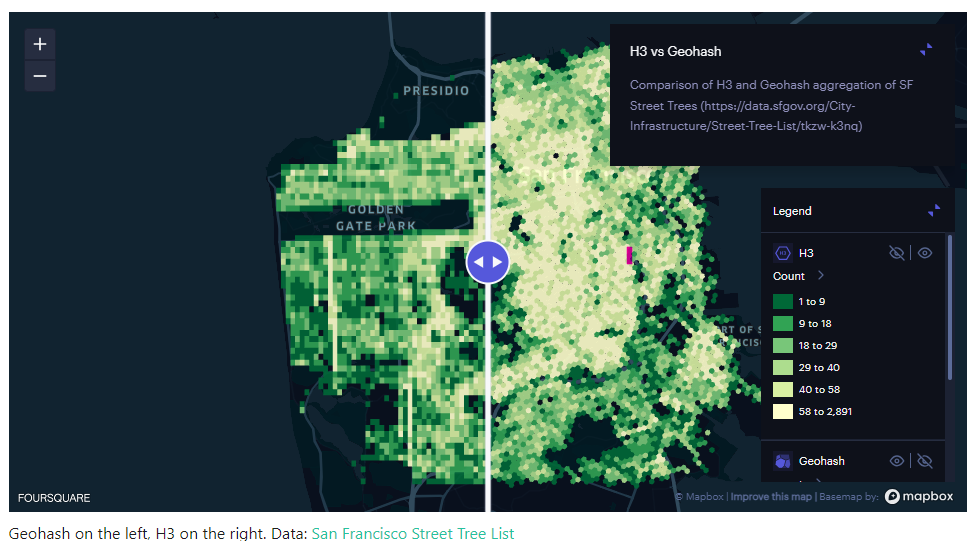
Source: H3
Geohash or H3: Choosing the Right System
The choice between Geohash and H3 depends on your specific use case:
- If you need a simple, lightweight encoding for basic spatial queries, Geohash remains a reliable and widely supported option.
- If you require advanced spatial analysis, consistent neighbour relationships, or large-scale aggregation, H3 is often better suited.
In real estate and property analytics, H3 can be particularly useful for applications such as price heatmapping, catchment analysis, and proximity-based insights.
Ultimately, both Geohash and H3 have their strengths. The best choice depends on your data, infrastructure, and analytical requirements.
Snowflake’s H3 Functionality
Snowflake provides SQL functions that enable you to use H3 with GEOGRAPHY objects.
More Intel from Data Army




The Fastest Way to Improve Location Analytics Isn’t Better Models. It’s Better Address Data

Intel In Your Inbox
Sign up to our newsletter and receive our latest knowledge articles, practical guides and datasets.