

Most analytics and AI initiatives don’t fail because the models are wrong or the tools are inadequate. They fail much earlier, often before meaningful modelling even begins.
Research cited by Melbourne Business School (MBS) indicates that more than 80% of data science, analytics, and AI projects fail to deliver their intended outcomes, despite growing investment in advanced analytics platforms and techniques. The reasons are rarely technical sophistication alone, but structural issues that prevent analytics from translating into value.
Despite advances in spatial analytics, cloud-native data platforms, and increasingly sophisticated models, data readiness and quality remain persistent failure points. As MBS highlights, many projects stall because organisations underestimate the foundational work required to prepare and operationalise data including governance, consistency, and usability across teams.
In the context of location analytics, this foundational gap most often appears at the address layer.
Spatial accuracy is capped by address quality
Modern analytics teams have access to powerful capabilities, namely native geospatial functions, scalable compute, rich visualisation layers and advanced modelling techniques.
Yet the accuracy of outputs is often constrained by inconsistent, fragmented, or poorly governed address data upstream.
This shows up as:
- Subtle spatial misalignment in joins
- Unexpected gaps in coverage analysis
- Aggregations that “look right” but don’t reconcile
- Models that behave inconsistently across regions
None of these issues trigger obvious errors.
But they can quietly degrade insight.
The common response is to refine models, tune parameters, or add more data.
Rarely is the root cause addressed: the address data itself.
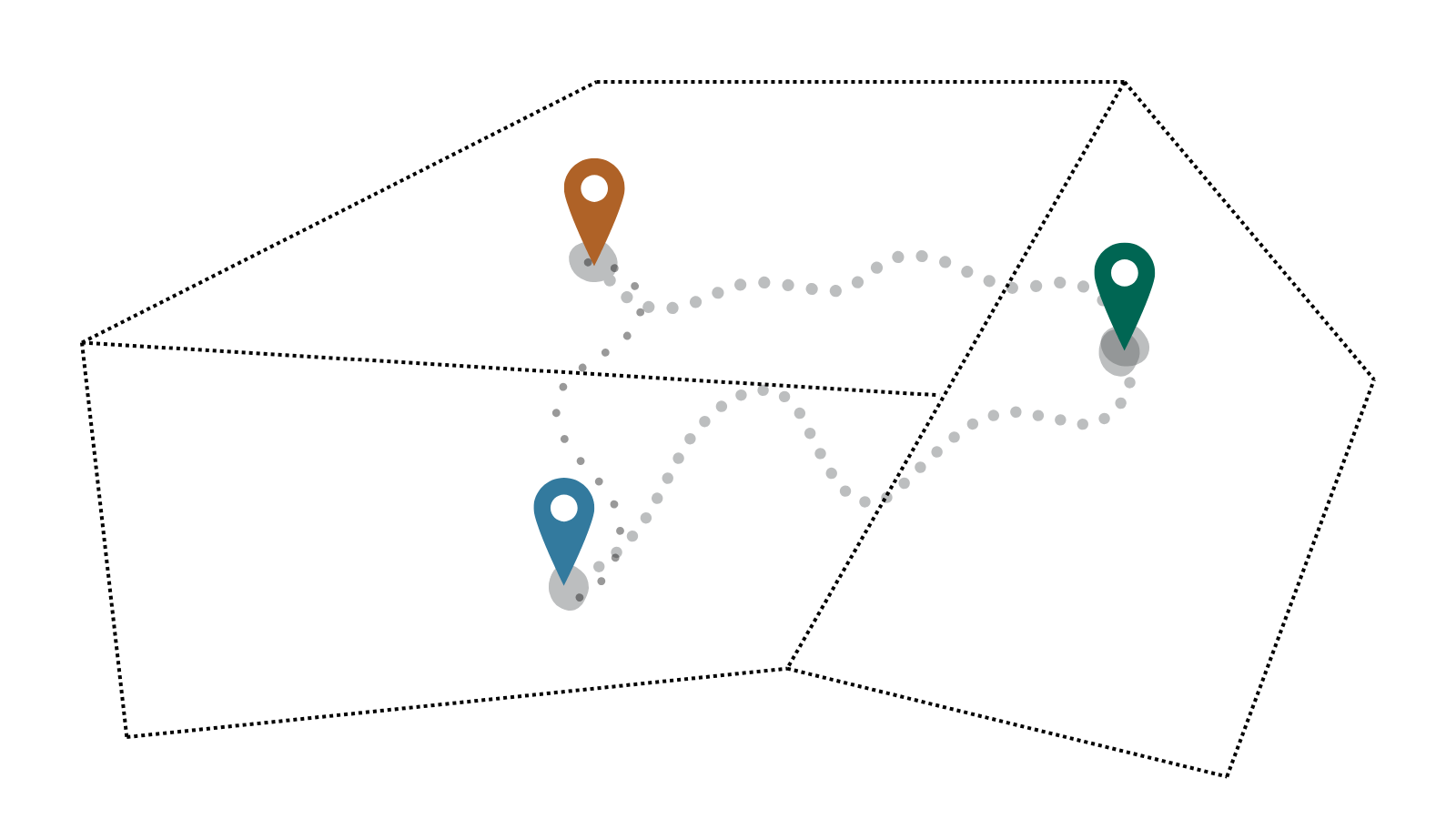
Network analysis is a type of geospatial data analysis that examines how locations are connected through routes and networks. This example shows how paths link multiple points across defined areas, helping reveal movement patterns, connectivity, and service reach.
Better geospatial tooling doesn’t fix weak foundations
Many modern data platforms now offer native geospatial capabilities making spatial analysis more accessible than ever. However, these functions still assume clean, consistently structured address inputs.
If addresses are:
Parsed differently by each team
Joined opportunistically rather than canonically
Rebuilt repeatedly across pipelines
Then location analytics becomes fragile, slow, and difficult to trust regardless of how advanced the downstream logic may be.
In other words, spatial accuracy degrades exponentially when address discipline is inconsistent.
Address data as reference data
A more effective approach is to treat address data not as enrichment, but as reference data:
- Shared once
- Governed centrally
- Reused consistently
- Consumed directly by analytics, BI, and modelling workflows
This shift delivers immediate benefits:
- More reliable spatial joins
- Consistent aggregation across teams
- Reduced rework in pipelines
- Faster experimentation and insight
It also removes a surprising amount of friction from analytics delivery because teams stop solving the same problem repeatedly.
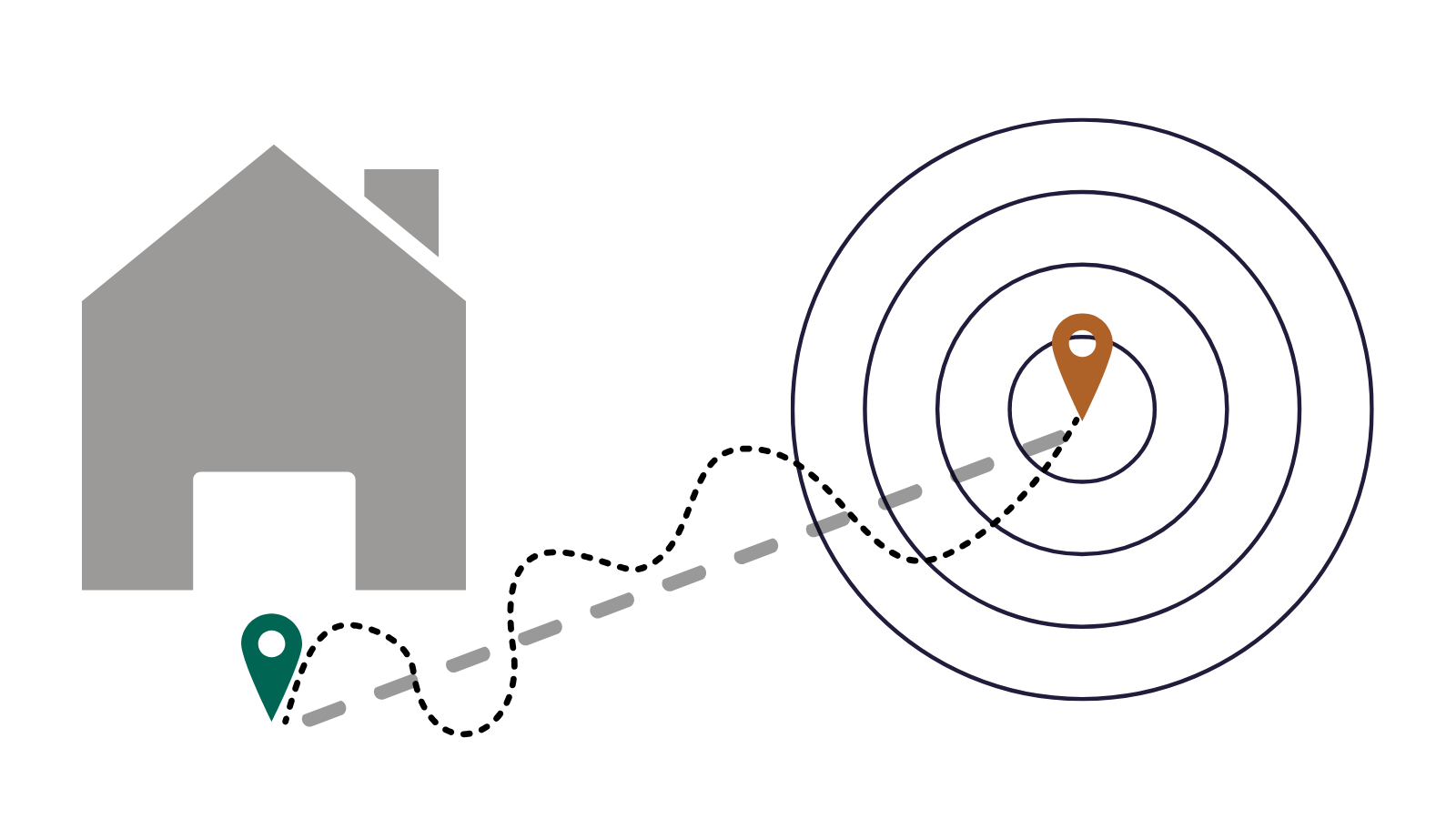
Geospatial measurement analysis calculates distance and proximity between locations. This example shows a measured route from a starting point to a destination, along with concentric buffer rings that represent distance zones around the target location.
The speed-to-insight advantage of off-the-shelf address data
By publishing address data directly through Snowflake Marketplace, Data Army Intel removes much of the friction from location analytics.
Snowflake’s native geospatial functions then enable teams to focus on spatial logic rather than data preparation.
- No ingestion pipelines
- No reformatting or reconciliation
- No duplicated logic across teams
- Secure, governed access by default
This is where address data from Data Army Intel becomes a practical advantage rather than a theoretical one.
- By starting with an analytics-ready, Snowflake-native address dataset, teams can:
- Focus on spatial logic, not data preparation
- Improve accuracy without increasing complexity
- Move faster without compromising governance
The “hack” isn’t better modelling.
It’s removing unnecessary friction before modelling even begins.
When foundational data is right, everything moves faster
Using an off-the-shelf dataset curated by data specialists removes a disproportionate amount of hidden effort from analytics workflows.
The heavy lifting of preparation, standardisation, and ongoing maintenance is done once upstream, improving consistency, reducing variability, and potentially eliminating a class of errors that may surface later in analysis.
When address data is treated as a trusted reference, analytics becomes both faster and more reliable. Teams can focus on applying spatial logic, testing hypotheses and generating insight.
Address Data available from Data Army Intel
Data Army Intel currently offers Address data for Australia and New Zealand from the Snowflake Marketplace.
More Intel from Data Army





Intel In Your Inbox
Sign up to our newsletter and receive our latest knowledge articles, practical guides and datasets.