
Your Guide to the European Union’s Official Statistics
If you’re looking for reliable statistics about Europe for research, business intelligence, policymaking or academic purposes, Eurostat is one of the best places to start.
As the official statistical office of the European Union, Eurostat publishes millions of trusted data points covering everything from population and inflation to agriculture, trade, tourism and renewable energy.
But what exactly is Eurostat, and why do governments, businesses, researchers and journalists rely on it? We’ll cover it here.
Table of Contents
Jump ahead ↓
What is Eurostat?
Eurostat is the statistical office of the European Union. Tracing its origins to the early 1950s, its role is to produce and publish high-quality European statistics that enable meaningful comparisons across countries and regions.
Rather than collecting most data itself, Eurostat works closely with the national statistical authorities of EU Member States, EFTA countries and other participating countries. These organisations collect data using internationally agreed methodologies before submitting it to Eurostat for validation, harmonisation and publication.
The result is a consistent, reliable and internationally comparable source of official European statistics that supports evidence-based decision-making across government, business and research.
Why is Eurostat important?
Reliable data supports better decisions.
Eurostat provides comparable statistics across Europe, allowing users to answer questions such as:
- Which EU country has the highest employment rate?
- How has inflation changed across Europe?
- Which countries produce the most renewable energy?
- Where is Europe’s population ageing the fastest?
- How has agricultural production changed over time?
- Which countries are Europe’s largest trading partners?
Because participating countries compile data using common statistical standards and methodologies, users can compare countries with confidence and make evidence-based decisions.
What data does Eurostat provide?
Eurostat publishes millions of statistical observations spanning virtually every sector of the European economy and society.
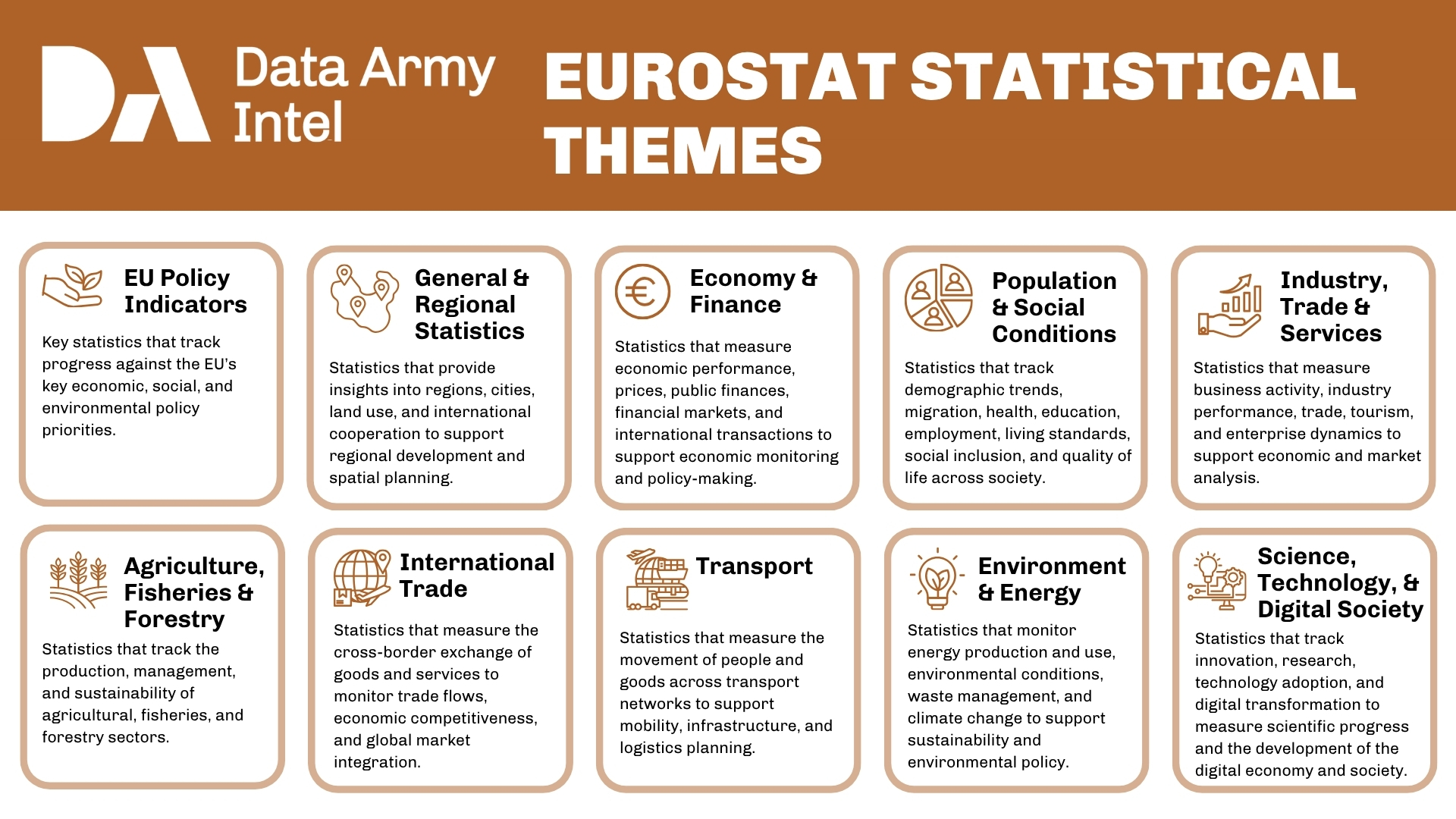
Its data is organised into 10 statistical themes:
- EU Policy indicators
- General and regional statistics
- Economy and finance
- Population and social conditions
- Industry, trade and services
- Agriculture, forestry and fisheries
- International trade
- Transport
- Environment and energy
- Science, technology and digital society
Within these themes, users can explore thousands of datasets covering:
-
Population and demographics
-
Inflation and consumer prices
-
Gross Domestic Product (GDP)
-
Employment and unemployment
-
Education
-
Tourism
-
Agriculture
-
Manufacturing
-
Energy
-
Climate and the environment
-
International trade
-
Health
-
Housing
-
Digital technology
Many datasets extend back several decades, making Eurostat invaluable for analysing long-term trends.
Who uses Eurostat?
Eurostat is used by a diverse range of organisations and professionals, including:
- European institutions
- National governments
- Policymakers
- Universities and researchers
- Businesses and consultants
- Economists
- Financial analysts
- Journalists
- Students
- Data scientists
- Manufacturers
- Real estate and property developers
- Logistics and transport companies
- Agriculture and food businesses
- Retailers and consumer brands
- Market researchers
Anyone seeking reliable European statistics can benefit from Eurostat’s extensive database.

Is Eurostat data free?
Yes.
Eurostat provides free access to its statistics through:
- The Eurostat Data Browser
- APIs for developers: API User guides – Eurostat
- Database Bulk downloads
- Eurostat Interactive Data visualisations
- Statistical publications and reports
Its commitment to open data has made Eurostat one of Europe’s most valuable public data resources.
How does Eurostat compare with other statistical organisations?
Eurostat is one of several organisations that publish official statistics.
Each has a different geographic or subject focus. While these organisations provide valuable information, Eurostat’s strength lies in producing harmonised, directly comparable statistics across Europe, making it the authoritative source for analysing EU-wide trends.
| Organisation | Primary Focus |
|
Official statistics for the European Union and participating European countries |
|
|
Economic, education and social statistics across 38 member countries worldwide |
|
|
Global development indicators including poverty, health, education and infrastructure |
|
|
|
International statistics compiled from UN agencies covering countries worldwide |
|
Macroeconomic, financial and fiscal statistics |
|
|
Agriculture, food security, fisheries, forestry and land use |
|
|
Employment, labour markets and working conditions |
|
|
Research-based visualisations combining data from many official sources |
|
|
Country-specific official statistics organisations
|
Challenges of working with Eurostat
Although Eurostat is an exceptional resource, many users find it challenging to navigate.
Common challenges include:
- Thousands of datasets with technical names
- Complex database structures
- Statistical codes and classifications
- Large multidimensional tables
- Multiple download formats
- Learning how to query the API
Finding the right dataset can sometimes take longer than analysing the data itself.
Making Eurostat data easier to use
For organisations that regularly work with European statistics, quick and intuitive access to trusted data can significantly improve productivity.
Data Army Intel brings together Eurostat’s official statistics across all 10 statistical themes in a streamlined platform, making it easier to discover, analyse and integrate European data into research, reporting and business intelligence workflows – so you can spend less time searching for data and more time generating insights.
Eurostat Data from Data Army Intel
Data Army Intel offers Eurostat data across all ten statistical themes, instantly accessible and ready to query in Snowflake.
More Intel from Data Army





Intel In Your Inbox
Sign up to our newsletter and receive our latest knowledge articles, practical guides and datasets.